Cracked concrete can result from poor ground preparation, not just the concrete mix or Colorado weather. What is fine grading in construction? It is the final shaping of the subgrade to meet the project’s elevation, slope, and compaction requirements.
In this article, learn how fine grading supports concrete stability and drainage and what to check in a contractor’s quote before starting your driveway, slab, or foundation project.
What Is Fine Grading in Construction, Simply Explained
Quick Answer: Fine grading is the final stage of site preparation, where crews shape the compacted subgrade to exact elevations within millimeter tolerances using laser-guided and GPS equipment.
Rough grading handles broad changes in ground level, while fine grading gives concrete uniform thickness and correct drainage.
Core definition in plain language
In plain terms, what is fine grading in construction? Think of the subgrade as the floor your slab stands on. Rough grading builds that floor in broad strokes, and fine grading finishes it, so every inch of the pour rests on the same prepared surface.
How it works in practice
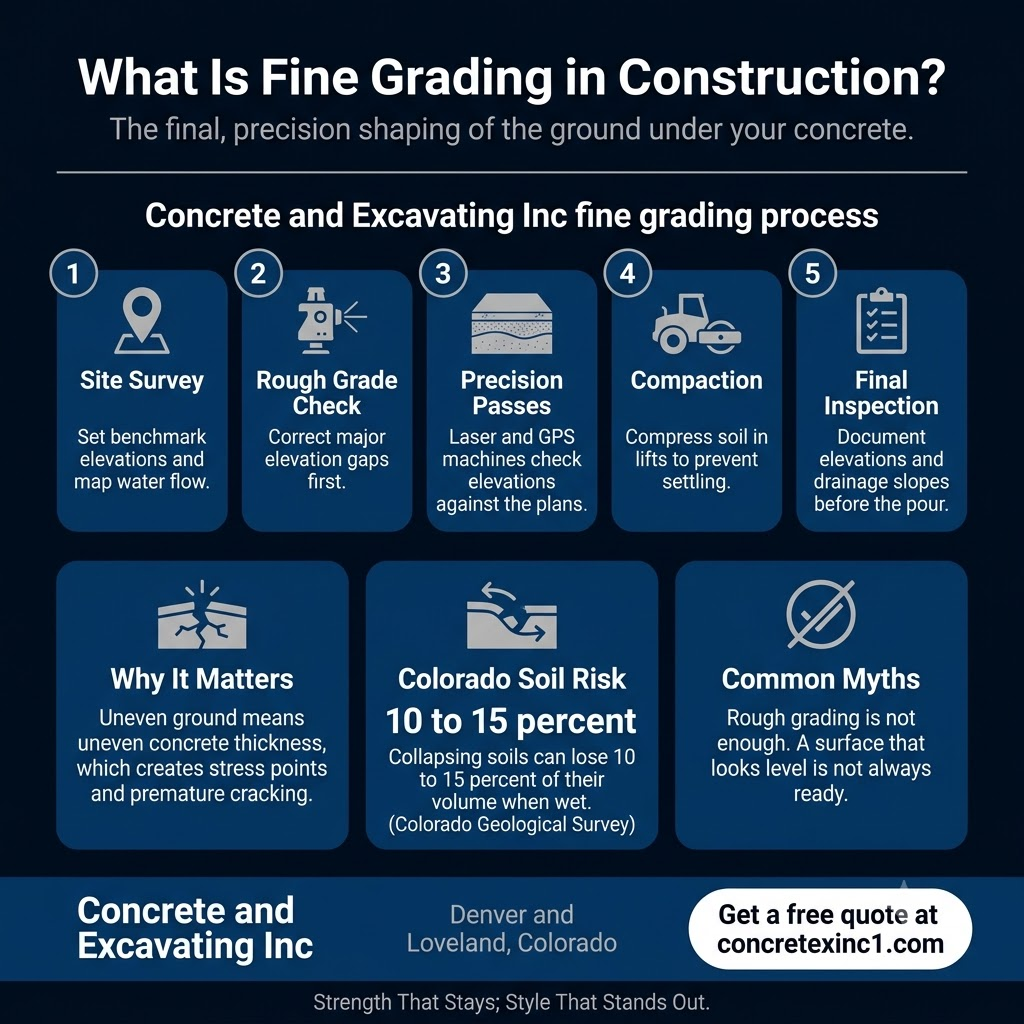
Concrete and Excavating Inc. runs fine grading through the sequence below before any concrete goes down.
- Site survey: The crew sets benchmark elevations and maps existing water flow against local building codes.
- Rough grade verification: The crew checks the primary earthwork and corrects major elevation gaps before precision equipment starts.
- Precision passes: Operators run laser-guided and GPS machinery over the site several times and check elevations against the plans.
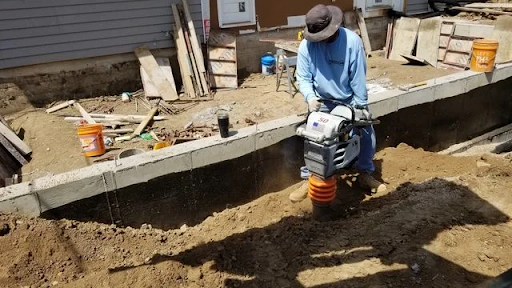
- Compaction: Machines compress the soil in structured lifts, which prevents settling after the pour.
- Final inspection: Survey equipment documents the final elevations and drainage slopes, and that record clears the site for the pour.
Why Fine Grading Matters to Concrete Owners
Quick Answer: An uneven subgrade produces concrete of uneven thickness, and uneven thickness creates stress points where cracks start. Fine grading removes that variable before the pour.
What uneven subgrades cost
Concrete over a low spot runs thicker, and concrete over a high spot runs thinner. Under load, those thickness changes concentrate stress and invite premature cracking.
According to the Concrete Pavement Technology Center, Iowa State University, non-uniform support or voids beneath a slab can lead to premature cracking and localized failures.
Settlement adds a second risk. According to the Colorado Geological Survey, collapsing soils can lose as much as 10 to 15 percent of their volume when wet, and the resulting settlement can severely damage foundations, pavements, and concrete slabs.
What a verified subgrade protects
A correctly sloped base moves water away from slabs and foundations. A documented final elevation check also gives you proof of the work before the pour.
Even on a perfect base, concrete shrinks as it cures, so control joints guide where any cracking occurs.
Soil evaluation still comes first. According to the City and County of Denver, Denver requires a geotechnical report from a registered design professional for new homes and townhouses and counts it as current only within two years of the permit application.
Fine grading supports that engineering work and does not replace it.
Common Misconceptions About Fine Grading
Quick Answer: Two beliefs lead to most grading problems: that rough grading is enough and that a surface that looks level is ready for concrete.
Misconception 1: “Rough grading is enough.”
Rough grading corrects major elevation differences across the site. It does not deliver the tight tolerances a slab needs.
Concrete and Excavating Inc. verifies the rough grade first and then finishes it with precision equipment. Skipping that handoff leaves the slab to absorb whatever the earthwork missed. A good quote lists the rough grade check as its own line item.
Misconception 2: “If it looks level, it is ready.”
Level is not the goal. Correct slope is. A surface can look flat and still sit too high or too low against the drainage plan.
Millimeter differences are hard to judge by eye. A fine grading contractor should show you survey confirmation of the elevations before the pour starts.
How Concrete and Excavating Inc. Helps With Fine Grading
Quick Answer: Concrete and Excavating Inc. handles fine grading alongside excavation and concrete work in Denver and Loveland, so you deal with one contractor from site preparation to the finished surface.
The service
The Fine Grading Construction service covers slab preparation, foundation grade preparation, concrete drainage integration, and post-concrete finish grading. It supports residential and commercial projects across Denver, Loveland, and the Front Range.
Broader grading services cover lot leveling, drainage, and stormwater management.
The process and pricing
Concrete and Excavating Inc. follows the survey, verification, precision, compaction, and inspection sequence in the previous section.
Excavation comes first, so its safety record matters. Eleven trench-related fatalities had been reported in 2025 as of June 28, according to the Occupational Safety and Health Administration.
Concrete and Excavating Inc. uses OSHA-compliant protective systems on excavations deeper than five feet, with daily competent-person inspections.
The company operates fully licensed and insured, brings over 30 years of experience in site development and construction, and runs background checks on its people. You also get direct contact with the owner.
Pricing stays transparent. You receive an open quote after an on-site inspection, plus before-and-after updates, so the fair price you approve stays true from day one.
Frequently Asked Questions
These answers cover the questions buyers ask most.
Q1. What is the difference between rough grading and fine grading?
Rough grading shapes the broad contours of a site, corrects major elevation differences, and redirects water. Fine grading follows it and refines the surface to exact elevations within millimeter tolerances. Concrete and Excavating Inc. verifies the rough grade first, so the precision work starts from a sound base.
Q2. How precise must fine grading be before the pour?
Fine grading works within specified millimeter tolerances. Operators check elevations against the engineering plans, and survey equipment confirms the result in a final inspection before the pour. The project plans and slab type set the exact tolerance, so the engineering specifications supply the number.
Q3. How much does fine grading cost in Denver?
Cost depends on site size, access, soil conditions, and scope. Concrete and Excavating Inc. provides an open quote after an on-site inspection.
Q4. Where can I get fine grading in Loveland, CO?
Concrete and Excavating Inc. operates from 766 Cottonwood Dr. in Loveland, CO. The company also serves Denver and the wider Front Range.
Conclusion
Fine grading prepares the ground for stable concrete, proper drainage, and the elevations your project requires. Before hiring a contractor for your driveway, slab, or foundation, confirm that the quote includes fine grading and a final elevation check.
Ready to prepare your site for concrete work? Request a free quote from Concrete and Excavating Inc. for grading and concrete services in Denver, Loveland, and the surrounding Front Range.