A flat lot does not automatically qualify for a concrete slab foundation. In Denver and Loveland, expansive soils can affect foundation stability, making soil conditions and drainage critical considerations, according to the Colorado Geological Survey.
What is a concrete slab foundation, and is it right for your property? In this guide, learn how grading, soil conditions, and drainage affect slab suitability before requesting a quote from Concrete and Excavating Inc.
What Is a Concrete Slab Foundation? Simply Explained
A concrete slab foundation is a reinforced, monolithic slab at ground level that carries the building’s weight, which makes it a fast, cost-effective choice for level sites.
Core definition in plain language
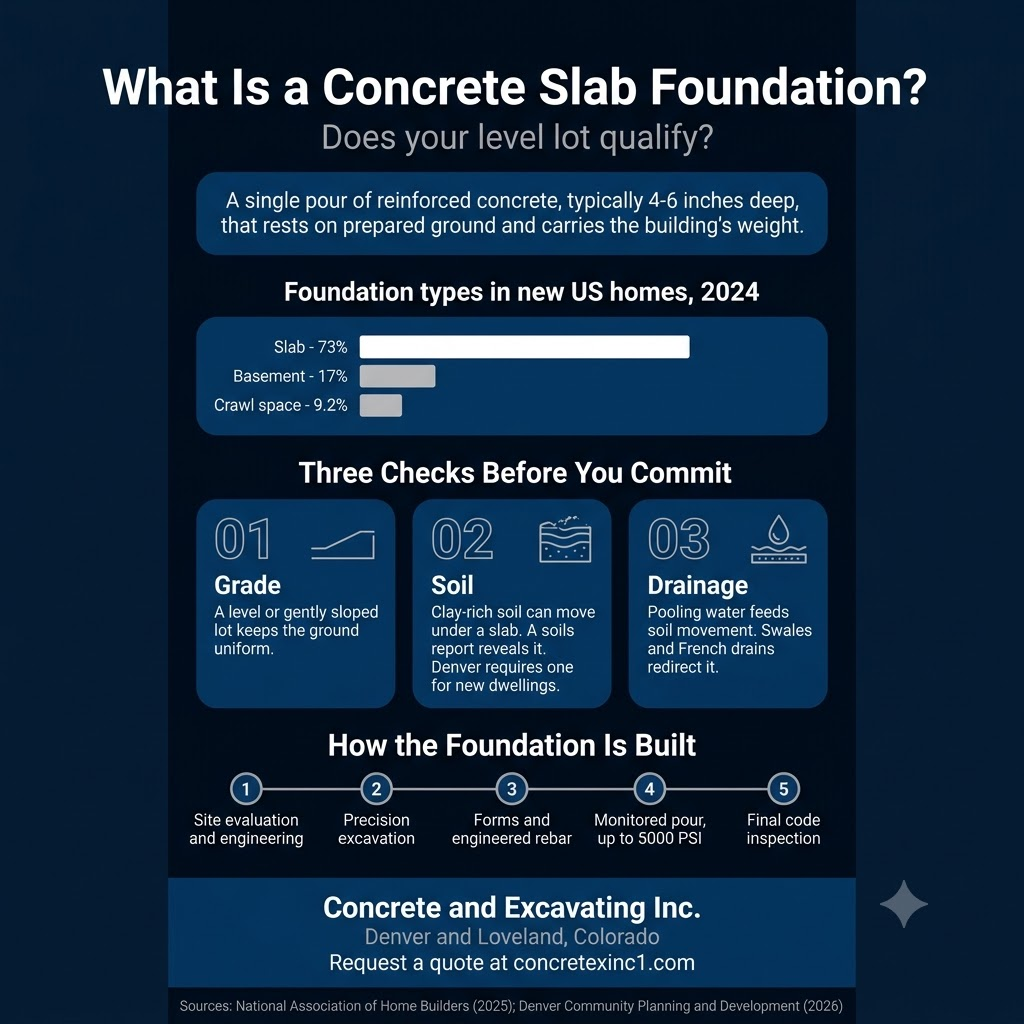
A concrete slab foundation, which contractors also call a slab-on-grade foundation, is a single monolithic pour of reinforced concrete, typically 4-6 inches deep in Concrete and Excavating Inc. projects, that rests on compacted ground.
Builders favor it for level topography and budget-conscious projects because it installs quickly. Colorado’s freeze-thaw cycles and expansive soils still shape its design.
Slabs now lead new construction nationwide: 73% of new single-family homes started in 2024 used slab foundations, compared with 17% for basements and 9.2% for crawl spaces, according to the National Association of Home Builders.
Other foundation types dig deeper. Concrete and Excavating Inc. excavates 8-10 feet for basements, builds crawl spaces 18-36 inches deep, and sets stem wall foundations at 12-24 inches with slab floors. A slab skips that depth, so your lot’s condition matters even more.
How it works in practice
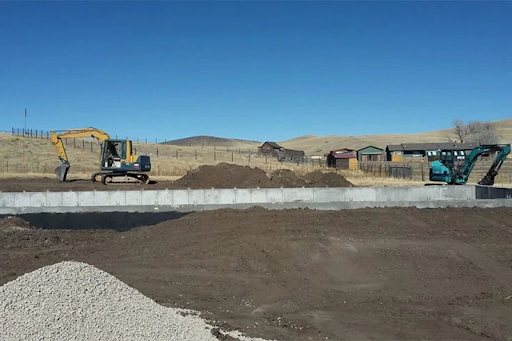
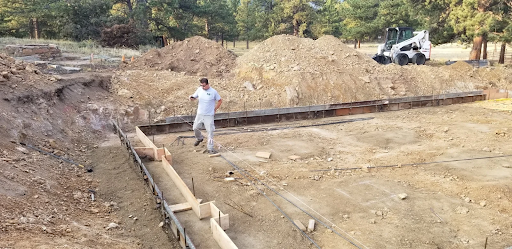
Every slab starts below the surface. Qualified crews strip topsoil, excavate to the engineered depth, and compact a granular base. Fine grading then sets exact elevations, because an uneven subgrade creates variable thickness and stress points that crack under load.
Forms, engineered rebar, and the monitored pour follow. Contraction joints then tell the concrete where to crack, which keeps the surface and structure intact.
Why a Concrete Slab Foundation Matters in Denver and Loveland
In Denver and Loveland, soil movement and freeze-thaw cycles decide how long the foundation performs, so lot conditions matter as much as the pour.
What goes wrong when a slab meets the wrong soil
Expansive clay swells when it absorbs water and shrinks as it dries. A slab on that soil can lift, drop, or crack unevenly. Front Range winters add freeze-thaw stress, because water in concrete’s pores expands as it freezes.
A 2026 review published in Geotechnical and Geological Engineering finds that expansive soils remain one of the most difficult and costly ground conditions in residential construction and that drainage, vegetation, and construction variability significantly influence performance.
Your lot qualification test: grade, soil report, and drainage
Three checks decide if your lot fits.
Three Checks Before You Commit
- Grade. A level or gently sloped lot keeps the subgrade uniform.
- Soil. Clay-rich or expansive soil can move under a slab, and a soils report reveals it.
- Drainage. Water that pools beside or under a slab feeds soil movement. Swales and French drains redirect it.
Denver sets a clear rule for soil testing. According to the Denver Community Planning and Development, Denver requires a geotechnical investigation report for new one- and two-family dwellings, townhouses, and conditioned accessory structures whenever expansive soils are likely at the site. Ask your contractor where the report fits in the schedule.
Common Misconceptions About a Concrete Slab Foundation
Two beliefs mislead owners: that any lot takes a slab and that a thin slab means a simple foundation.
“Any lot can take a slab if the pour is done correctly.”
A flawless pour cannot fix a poor base. Excavation, compaction, and fine grading come first, and skipping them invites early cracking. Fine grading also matches slopes to the final concrete layout, so drainage runs away from the structure.
Utility locating happens before trenching, so buried water, sewer, and electrical lines stay protected.
“A thin slab means a simple foundation.”
Four to six inches of depth sounds simple. A thin profile leaves less margin for poor soil or an uneven base.
Engineered reinforcement, frost-protection parameters, and a final inspection against Denver and Loveland building codes keep the structure sound. Concrete and Excavating Inc. begins every foundation with site evaluation and engineering for that reason.
How Concrete and Excavating Inc. Helps With a Concrete Slab Foundation
Concrete and Excavating Inc. handles excavation, fine grading, and slab installation under one roof, with direct owner contact and a fair price quote that follows an on-site inspection.
Concrete slab foundations in Denver and Loveland
Concrete and Excavating Inc. serves Denver, Loveland, and neighboring Front Range communities with new slab installation, slab extensions, and slab replacement.
Excavation for the building site, footing trenches, and fine grading come from one team. You coordinate a single contractor instead of several trades, and the owner stays your direct contact.
What the process looks like
Concrete and Excavating Inc. follows five steps on every foundation.
- Site evaluation and engineering, which sets load-bearing capacity and frost protection.
- Precision excavation to the correct dimensions.
- Accurate forms with engineered rebar placement.
- Monitored pouring of high-quality concrete that supports up to 5000 PSI.
- Final inspections that verify compliance with Denver and Loveland building codes.
Pricing follows the Fair Price model. An on-site property inspection fixes the scope of work, and open quotes stay true from day one.
Frequently Asked Questions
A soils report, a level lot, and sound drainage answer most questions about a slab.
Q1. Do I need a soils report before pouring a concrete slab foundation in Denver?
Yes, for a new dwelling. The Denver Community Planning and Development states that Denver requires a registered design professional with geotechnical experience and counts as current when its date falls within two years of permit submittal.
Q2. How thick is a concrete slab foundation?
Concrete and Excavating Inc. typically builds a concrete slab foundation 4-6 inches deep. The engineered design for your lot sets the final thickness.
Q3. Is a concrete slab foundation cost-effective for a level lot?
Level topography suits it, and installation stays rapid and cost-effective. Soil and grading needs shape the final scope.
Q4. Can a concrete slab foundation handle Colorado freeze-thaw and expansive soil?
Yes, when the design matches the soil. Concrete and Excavating Inc. applies Solid Strength and Weather Ready engineering: ASTM C94 mixes with controlled air entrainment, 5000 PSI capacity, and planned contraction joints. Highly expansive soil may call for a different design.
Q5. How do I get a quote for a concrete slab foundation in Loveland or Denver?
The process starts with an on-site property inspection that fixes the scope of work. An open quote follows, and before-and-after updates continue during the project.
Conclusion
A concrete slab foundation can be a practical choice for level lots, but soil conditions, grading, and drainage determine whether it is suitable for your property. A geotechnical soils report and proper site assessment help identify potential risks before construction begins.
Ready to plan your concrete slab foundation? Contact Concrete and Excavating Inc. to request a quote and schedule an on-site assessment in Denver or Loveland. Get a quote and discuss your foundation project’s requirements with the team.